
Overview
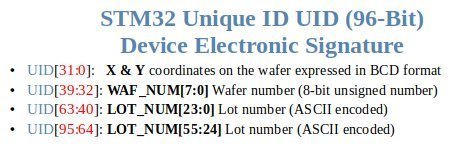
The STM32 Unique ID is a 96-bit electronic signature built into every STM32 microcontroller, useful for differentiating devices in client/server or distributed systems. STM32 provides three HAL functions to retrieve this value — HAL_GetUIDw0(), HAL_GetUIDw1(), and HAL_GetUIDw2() — which return the following fields:
- UID[31:0]: X & Y coordinates on the wafer expressed in BCD format
- UID[39:32]: WAF_NUM[7:0] Wafer number (8-bit unsigned number)
- UID[63:40]: LOT_NUM[23:0] Lot number (ASCII encoded)
- UID[95:64]: LOT_NUM[55:24] Lot number (ASCII encoded)
Since this tutorial was first published, a newer companion post — STM32 Device Electronic Signature Read and Print — has gone up covering the same 96-bit UID shown here, plus the DBGMCU device/revision ID and flash capacity register, with everything printed live over USART on a Nucleo-H753ZI. If you want the fuller picture of a chip’s electronic signature with real serial output to look at, it’s worth a read.
Because 96 bits can be difficult to manage directly, this tutorial also demonstrates how to reduce the full ID to a 32-bit value using a simplified CityHash algorithm included in the provided source code.
Schematic
In this particular tutorial, there really isn’t specific hardware settings or a schematic. This tutorial primarily shows the code that is pertinent for gathering and utilizing the Unique Device Serial Information.
Pinouts & Configurations
None of the Pins or Configurations settings really matter in this tutorial. Defaults can be used and that will suffice.
Code Walkthrough
main.h
/* USER CODE BEGIN Header */
/**
  ******************************************************************************
  * @file           : main.h
  * @brief          : Header for main.c file.
  *                   This file contains the common defines of the application.
  ******************************************************************************
  * @attention
  *
  * Copyright (c) 2024 STMicroelectronics.
  * All rights reserved.
  *
  * This software is licensed under terms that can be found in the LICENSE file
  * in the root directory of this software component.
  * If no LICENSE file comes with this software, it is provided AS-IS.
  *
  ******************************************************************************
  */
/* USER CODE END Header */

/* Define to prevent recursive inclusion -------------------------------------*/
#ifndef __MAIN_H
#define __MAIN_H

#ifdef __cplusplus
extern "C" {
#endif

/* Includes ------------------------------------------------------------------*/
#include "stm32l4xx_hal.h"

/* Private includes ----------------------------------------------------------*/
/* USER CODE BEGIN Includes */

/* USER CODE END Includes */

/* Exported types ------------------------------------------------------------*/
/* USER CODE BEGIN ET */

/* USER CODE END ET */

/* Exported constants --------------------------------------------------------*/
/* USER CODE BEGIN EC */

/* USER CODE END EC */

/* Exported macro ------------------------------------------------------------*/
/* USER CODE BEGIN EM */

/* USER CODE END EM */

/* Exported functions prototypes ---------------------------------------------*/
void Error_Handler(void);

/* USER CODE BEGIN EFP */

/* USER CODE END EFP */

/* Private defines -----------------------------------------------------------*/

/* USER CODE BEGIN Private defines */

/* USER CODE END Private defines */

#ifdef __cplusplus
}
#endif

#endif /* __MAIN_H */
main.c
The highlighted code is all that is needed to be able to get a hashed uint32_t value of the 96 bits to make it a truly unique and a manageable serial number. This code can be placed into it’s own function, because it is stand-a-lone.
/* USER CODE BEGIN Header */
/**
  ******************************************************************************
  * @file           : main.c
  * @brief          : Main program body
  ******************************************************************************
  * @attention
  *
  * Copyright (c) 2024 STMicroelectronics.
  * All rights reserved.
  *
  * This software is licensed under terms that can be found in the LICENSE file
  * in the root directory of this software component.
  * If no LICENSE file comes with this software, it is provided AS-IS.
  *
  ******************************************************************************
  */
/* USER CODE END Header */
/* Includes ------------------------------------------------------------------*/
#include "main.h"

/* Private includes ----------------------------------------------------------*/
/* USER CODE BEGIN Includes */
#include "stdio.h"
#include "string.h"
#include "stm32_uidhash.h"
/* USER CODE END Includes */

/* Private typedef -----------------------------------------------------------*/
/* USER CODE BEGIN PTD */

/* USER CODE END PTD */

/* Private define ------------------------------------------------------------*/
/* USER CODE BEGIN PD */

/* USER CODE END PD */

/* Private macro -------------------------------------------------------------*/
/* USER CODE BEGIN PM */

/* USER CODE END PM */

/* Private variables ---------------------------------------------------------*/

/* USER CODE BEGIN PV */

/* USER CODE END PV */

/* Private function prototypes -----------------------------------------------*/
void SystemClock_Config(void);
/* USER CODE BEGIN PFP */

/* USER CODE END PFP */

/* Private user code ---------------------------------------------------------*/
/* USER CODE BEGIN 0 */

/* USER CODE END 0 */

/**
  * @brief  The application entry point.
  * @retval int
  */
int main(void)
{

  /* USER CODE BEGIN 1 */

  /* USER CODE END 1 */

  /* MCU Configuration--------------------------------------------------------*/

  /* Reset of all peripherals, Initializes the Flash interface and the Systick. */
  HAL_Init();

  /* USER CODE BEGIN Init */

  /* USER CODE END Init */

  /* Configure the system clock */
  SystemClock_Config();

  /* USER CODE BEGIN SysInit */

  /* USER CODE END SysInit */

  /* Initialize all configured peripherals */
  /* USER CODE BEGIN 2 */

	uint32_t uid[3] = {0x00};
	char buff[12];

	uid[0] = HAL_GetUIDw0();
	uid[1] = HAL_GetUIDw1();
	uid[2] = HAL_GetUIDw2();

	memcpy(&buff[8], &uid[0], 4);
	memcpy(&buff[4], &uid[1], 4);
	memcpy(&buff[0], &uid[2], 4);

	uint32_t uuid = Hash32Len5to12((const char *) &buff, 12);

	char hashedUUID[80];
	sprintf(hashedUUID, "0x%8.8lx", uuid);

  /* USER CODE END 2 */

  /* Infinite loop */
  /* USER CODE BEGIN WHILE */
  while (1)
  {
    /* USER CODE END WHILE */

    /* USER CODE BEGIN 3 */
  }
  /* USER CODE END 3 */
}

/**
  * @brief System Clock Configuration
  * @retval None
  */
void SystemClock_Config(void)
{
  RCC_OscInitTypeDef RCC_OscInitStruct = {0};
  RCC_ClkInitTypeDef RCC_ClkInitStruct = {0};

  /** Configure the main internal regulator output voltage
  */
  if (HAL_PWREx_ControlVoltageScaling(PWR_REGULATOR_VOLTAGE_SCALE1) != HAL_OK)
  {
    Error_Handler();
  }

  /** Initializes the RCC Oscillators according to the specified parameters
  * in the RCC_OscInitTypeDef structure.
  */
  RCC_OscInitStruct.OscillatorType = RCC_OSCILLATORTYPE_MSI;
  RCC_OscInitStruct.MSIState = RCC_MSI_ON;
  RCC_OscInitStruct.MSICalibrationValue = 0;
  RCC_OscInitStruct.MSIClockRange = RCC_MSIRANGE_6;
  RCC_OscInitStruct.PLL.PLLState = RCC_PLL_ON;
  RCC_OscInitStruct.PLL.PLLSource = RCC_PLLSOURCE_MSI;
  RCC_OscInitStruct.PLL.PLLM = 1;
  RCC_OscInitStruct.PLL.PLLN = 40;
  RCC_OscInitStruct.PLL.PLLP = RCC_PLLP_DIV2;
  RCC_OscInitStruct.PLL.PLLQ = RCC_PLLQ_DIV2;
  RCC_OscInitStruct.PLL.PLLR = RCC_PLLR_DIV2;
  if (HAL_RCC_OscConfig(&RCC_OscInitStruct) != HAL_OK)
  {
    Error_Handler();
  }

  /** Initializes the CPU, AHB and APB buses clocks
  */
  RCC_ClkInitStruct.ClockType = RCC_CLOCKTYPE_HCLK|RCC_CLOCKTYPE_SYSCLK
                              |RCC_CLOCKTYPE_PCLK1|RCC_CLOCKTYPE_PCLK2;
  RCC_ClkInitStruct.SYSCLKSource = RCC_SYSCLKSOURCE_PLLCLK;
  RCC_ClkInitStruct.AHBCLKDivider = RCC_SYSCLK_DIV1;
  RCC_ClkInitStruct.APB1CLKDivider = RCC_HCLK_DIV2;
  RCC_ClkInitStruct.APB2CLKDivider = RCC_HCLK_DIV1;

  if (HAL_RCC_ClockConfig(&RCC_ClkInitStruct, FLASH_LATENCY_4) != HAL_OK)
  {
    Error_Handler();
  }
}

/* USER CODE BEGIN 4 */

/* USER CODE END 4 */

/**
  * @brief  This function is executed in case of error occurrence.
  * @retval None
  */
void Error_Handler(void)
{
  /* USER CODE BEGIN Error_Handler_Debug */
  /* User can add his own implementation to report the HAL error return state */
  __disable_irq();
  while (1)
  {
  }
  /* USER CODE END Error_Handler_Debug */
}

#ifdef  USE_FULL_ASSERT
/**
  * @brief  Reports the name of the source file and the source line number
  *         where the assert_param error has occurred.
  * @param  file: pointer to the source file name
  * @param  line: assert_param error line source number
  * @retval None
  */
void assert_failed(uint8_t *file, uint32_t line)
{
  /* USER CODE BEGIN 6 */
  /* User can add his own implementation to report the file name and line number,
     ex: printf("Wrong parameters value: file %s on line %d\r\n", file, line) */
  /* USER CODE END 6 */
}
#endif /* USE_FULL_ASSERT */
stm32_uidhash.h
#ifndef INC_STM32_UIDHASH_H_
#define INC_STM32_UIDHASH_H_

#include "main.h"

uint32_t Hash32Len5to12(const char *s, size_t len);

#endif /* INC_STM32_UIDHASH_H_ */stm32_uidhash.c
Some of this code was taken from other algorithms, such at MurmurHash Also, special thanks to this site: Generating 32-bit STM32 Unique ID
#include <stdio.h>
#include <string.h>

#include "stm32_uidhash.h"

// Magic numbers for 32-bit hashing.  Copied from Murmur3.
static const uint32_t c1 = 0xcc9e2d51;
static const uint32_t c2 = 0x1b873593;

static uint32_t UNALIGNED_LOAD32(const char *p) {
  uint32_t result;
  memcpy(&result, p, sizeof(result));
  return result;
}

static uint32_t Fetch32(const char *p) {
  return UNALIGNED_LOAD32(p);
}

static uint32_t Rotate32(uint32_t val, int shift) {
  // Avoid shifting by 32: doing so yields an undefined result.
  return shift == 0 ? val : ((val >> shift) | (val << (32 - shift)));
}

// A 32-bit to 32-bit integer hash copied from Murmur3.
static uint32_t fmix(uint32_t h)
{
  h ^= h >> 16;
  h *= 0x85ebca6b;
  h ^= h >> 13;
  h *= 0xc2b2ae35;
  h ^= h >> 16;
  return h;
}

static uint32_t Mur(uint32_t a, uint32_t h) {
  // Helper from Murmur3 for combining two 32-bit values.
  a *= c1;
  a = Rotate32(a, 17);
  a *= c2;
  h ^= a;
  h = Rotate32(h, 19);
  return h * 5 + 0xe6546b64;
}

uint32_t Hash32Len5to12(const char *s, size_t len) {
  uint32_t a = (uint32_t)len, b = a * 5, c = 9, d = b;
  a += Fetch32(s);
  b += Fetch32(s + len - 4);
  c += Fetch32(s + ((len >> 1) & 4));
  return fmix(Mur(c, Mur(b, Mur(a, d))));
}
If you have questions or run into trouble getting the boards programmed and talking to each other, post in the Tutorial Support forum and I will work through it with you. If project source is not linked in the tutorial, it may be available on request — use the email contact option in the site footer.